The “Minor” Prophets: Hosea Through Malachi
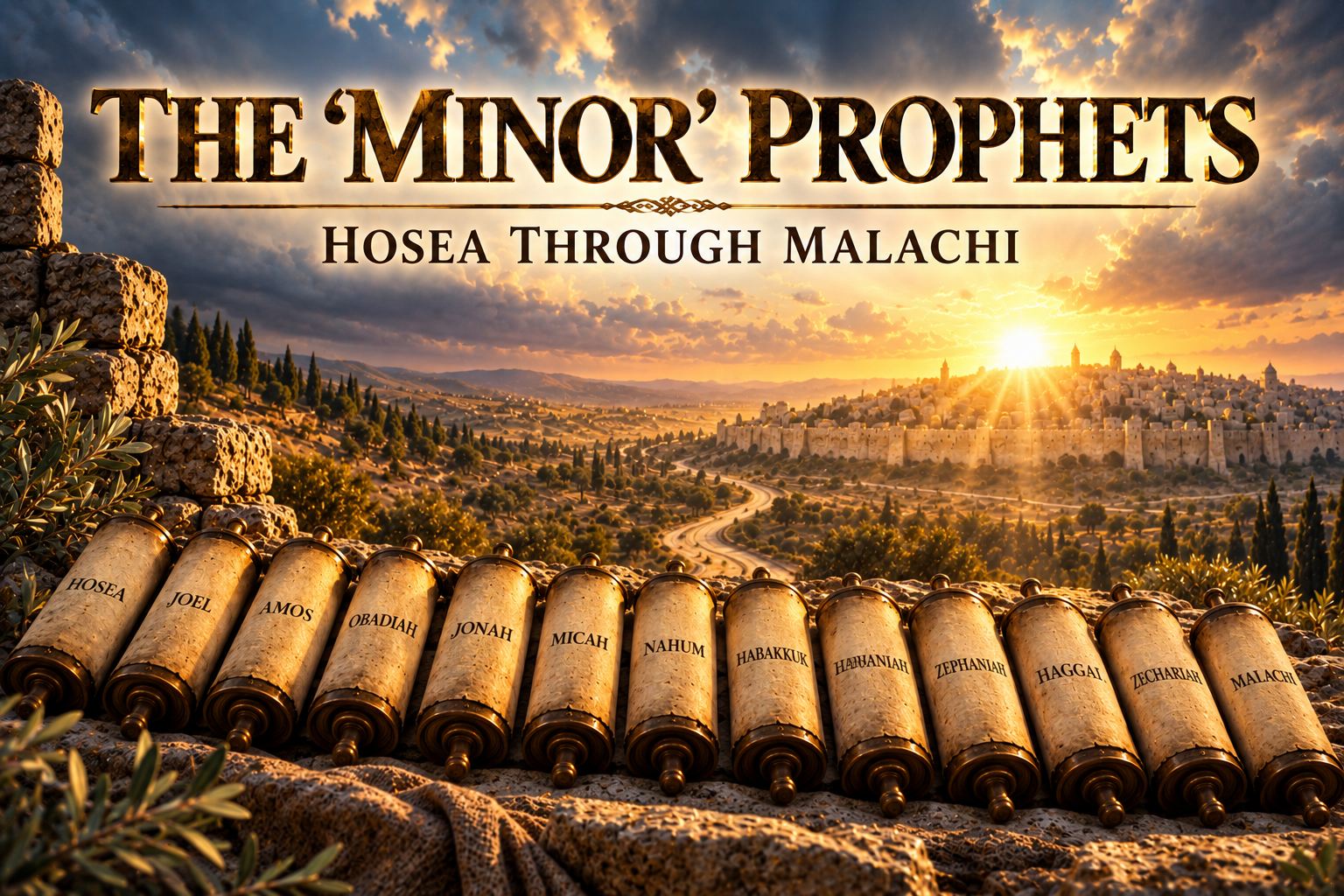
THE ‘MINOR’ PROPHETS – ‘Hosea through Malachi’
──────────────────────────────────────────────────────────────
INTRODUCTION
The twelve Minor Prophets span several centuries of Israel's history,
from the divided monarchy through the post-exilic restoration.
The designation "Minor" refers to the relative brevity of these books, not to
their theological weight — each carries a full prophetic voice. Together, the
Twelve form a unified witness to God's covenant faithfulness: His holy justice
against sin, His relentless hesed pursuing a wayward people, and the rising
horizon of Messianic hope that the New Testament declares fulfilled in Jesus Christ.
SIX UNIFYING THREADS THROUGH ALL TWELVE BOOKS
Though separated by centuries, audiences, and literary styles, the Twelve
Prophets speak with one voice on these foundational themes:
1. THE DAY OF THE LORD
History moves toward a decisive divine intervention — both judgment on the
unrepentant and salvation for the faithful. Every prophet sounds this note
(Joel, Amos, Zephaniah, Malachi especially).
2. COVENANT LOVE (hesed) & HOLINESS
God's twin attributes cannot be separated: His love pursues relentlessly
(Hosea), but His holiness demands covenant fidelity. Grace is never cheap
in the Twelve.
3. CALL TO REPENTANCE (shub)
"Return to Me, and I will return to you" (Malachi 3:7) is the heartbeat of
prophetic preaching. God calls, judges, and calls again — the door of return
stands open until the very last page.
4. SOCIAL JUSTICE
True worship is proven in the treatment of the poor, widow, orphan, and
stranger. Amos, Micah, Zechariah, and Malachi all make the connection between
liturgy and ethics unavoidable.
5. THE REMNANT
God never abandons His purposes or His people entirely. Within every wave of
judgment, a faithful remnant is preserved — the seed of a renewed covenant
community (Zephaniah 3:12–13, Zechariah 8).
6. MESSIANIC HOPE
Every prophet ultimately points beyond Israel's history toward the Coming King —
born in Bethlehem (Micah 5:2), riding in on a donkey (Zechariah 9:9), preceded
by a forerunner (Malachi 3:1) and ruling in justice and peace forever.
THE TWELVE PROPHETS
─────────────────────────────────────────────────────
1. HOSEA — ‘God's Unfailing Love’
c. 755–715 BC | Northern Israel | Key Verse: 14:1
Hosea married the unfaithful Gomer as a living parable of Israel's spiritual
adultery against God. Despite repeated covenant betrayal, God pursues His people
with hesed — steadfast, loyal love that refuses to let go. The book alternates
between heartbreaking accusation and breathtaking tenderness, culminating in
God's invitation: "Return to Me." Jesus quotes Hosea 6:6 ("I desire mercy, not
sacrifice") twice in Matthew, and Hosea 11:1 is fulfilled in Matthew 2:15.
──────────────────────────────────────────────────────
2. JOEL — The Day of the Lord
Debated: c. 835 or ~400 BC | Judah | Key Verse: 2:28
A devastating locust plague becomes the occasion for Joel's urgent call to
national repentance — not garment-rending but heart-rending (2:13). Joel
develops the most extensive "Day of the LORD" vision in the Minor Prophets:
darkness for the unrepentant, glorious deliverance for all who call on His name.
His prophecy of the Spirit poured out on "all flesh" (2:28–32) is directly
quoted by Peter at Pentecost in Acts 2 as the key to understanding the birth of the church.
──────────────────────────────────────────────────────
3. AMOS — Justice Like a Flood
c. 760–750 BC | Northern Israel | Key Verse: 5:24
Amos was a layman — a shepherd and fig-farmer from Judah — sent by God into
the prosperous but unjust northern kingdom. He thunders that elaborate worship
coexisting with social oppression is not worship but abomination ("Let justice
roll down like waters," 5:24). His rhetorical genius: he first indicts Israel's
neighbors before wheeling around to indict Israel herself. James 2 and Acts 15
(citing Amos 9:11) both echo his voice.
──────────────────────────────────────────────────────
4. OBADIAH — Pride Before the Fall
c. 586 BC | Edom | Key Verse: v. 15
The shortest book in the Old Testament (21 verses) delivers a laser-focused
oracle against Edom — descendants of Esau, Israel's closest kin — who celebrated
when Babylon destroyed Jerusalem. Obadiah diagnoses Edom's root sin as pride
("The pride of your heart has deceived you," v. 3) and announces the inescapable
principle: "As you have done, it shall be done to you" (v. 15). The book closes
with the sweeping declaration: "The kingdom shall be the LORD's."
──────────────────────────────────────────────────────
5. JONAH — God's Grace Has No Borders
c. 780–760 BC | Nineveh/Assyria | Key Verse: 4:11
Jonah is the Minor Prophets' most striking narrative: a prophet who flees his
commission because he does not want God to forgive Israel's most feared enemy.
When he finally goes, the entire city repents — and God relents. The book ends
not with celebration but with God's unanswered question: "Should I not pity
Nineveh?" Jesus cites Jonah's three days in the fish as a sign of His own death
and resurrection (Matthew 12:39–41) and holds up Nineveh's repentance as a rebuke to the unrepentant.
──────────────────────────────────────────────────────
6. MICAH — What Does the LORD Require?
c. 735–700 BC | Israel & Judah | Key Verse: 6:8
A rural prophet from the Shephelah lowlands, Micah speaks for the dispossessed
poor against corrupt rulers and false prophets in Jerusalem. He distills the
entire covenant into three verbs: "do justice, love kindness, walk humbly with
your God" (6:8). Micah contains one of Scripture's most precise Messianic
prophecies — naming Bethlehem as the Ruler's birthplace (5:2), quoted by Herod's
scribes when the Magi arrived (Matthew 2:5–6). The book closes: "Who is a God
like You, pardoning iniquity?"
─────────────────────────────────────────────────────
7. NAHUM — The Fall of the Oppressor
c. 650–620 BC | Nineveh | Key Verse: 1:7
Read alongside Jonah, Nahum completes the Nineveh story: a century after the
city repented, it has returned to brutal violence, and divine judgment is now
irrevocable. His vivid war poetry announces Nineveh's fall — and for nations
groaning under Assyrian terror, this is genuinely good news. The pastoral gem
at the center of his judgment oracle — "The LORD is good, a stronghold in the
day of trouble" (1:7) — reminds us that divine wrath and divine refuge are not
contradictions. Nahum 1:15 echoes Isaiah 52:7, linking justice to gospel.
──────────────────────────────────────────────────────
8. HABAKKUK — Wrestling with God
c. 605 BC | Judah | Key Verse: 2:4
Habakkuk alone among the prophets argues directly with God, demanding to know
why injustice in Judah goes unpunished — then why God would use the even-more-
wicked Babylonians as His instrument. God's response does not fully resolve the
"why" but gives Habakkuk something better: a vision of His own sovereign majesty,
and the declaration that "the righteous shall live by faith" (2:4). This single
verse launched the Protestant Reformation when Luther encountered it in Romans
1:17. The book closes with one of Scripture's most triumphant acts of faith
(3:17–19).
──────────────────────────────────────────────────────
9. ZEPHANIAH — Judgment, Remnant, and Joy
c. 630–625 BC | Judah & Nations | Key Verse: 3:17
A descendant of King Hezekiah, Zephaniah delivers the most sweeping Day of the
LORD announcement in the Minor Prophets ("I will utterly sweep away everything,"
1:2–3) before pivoting to one of the most tender expressions of divine love in
all Scripture: God singing over His restored people with joy (3:17). The book
traces an arc from comprehensive judgment through remnant preservation to
eschatological celebration. Zephaniah 3:9 anticipates the Spirit's reversal of
Babel — fulfilled at Pentecost — and the remnant of 3:12 mirrors Jesus's Beatitudes.
──────────────────────────────────────────────────────
10. HAGGAI — Rebuild What Matters
520 BC precisely | Returned Exiles | Key Verse: 1:4
The most precisely dated book in biblical prophecy, Haggai's four oracles span
just four months in 520 BC. The returned exiles have let the temple lie in ruins
for sixteen years while finishing their own paneled houses — and God's response
is a call to "consider your ways." When the community obeys and begins building,
God responds immediately: "I am with you" (1:13). Haggai's promise that "the
latter glory of this house will be greater than the former" (2:9) is quoted in
Hebrews 12:26–27 and fulfilled in Christ, the true temple.
──────────────────────────────────────────────────────
11. ZECHARIAH — Visions of the Coming King
c. 520–480 BC | Returned Exiles | Key Verse: 9:9
The most extensively Messianic of the Minor Prophets, Zechariah opens with eight
vivid night visions and closes with sweeping apocalyptic oracles. More passages
from Zechariah 9–14 appear in the Passion narratives than from any other Minor
Prophet section: the King on a donkey (9:9; Matthew 21:5), thirty pieces of
silver (11:12–13; Matthew 27:9), the stricken shepherd (13:7; Matthew 26:31),
and the pierced one mourned by all (12:10; John 19:37). His foundational verse —
"Not by might, nor by power, but by My Spirit" (4:6) — anchors all true ministry.
──────────────────────────────────────────────────────
12. MALACHI — The Last Voice Before Silence
c. 430–420 BC | Judah | Key Verse: 3:1
The final prophetic voice before four centuries of silence, Malachi confronts a
post-exilic community whose worship has become rote: blind and lame animal
offerings, withheld tithes, treacherous divorces, and the cynical question,
"Is it vain to serve God?" (3:14). Using a punchy call-and-response format, God
answers each cynical objection with devastating specificity before promising a
coming messenger (3:1 — fulfilled in John the Baptist) and the returning "Elijah"
before the Day of the LORD (4:5–6 — cited by Jesus in Matthew 11:14). Hope
flickers bright at the very end of the Old Testament canon.
More in Articles
October 6, 2026
The Gospel of Mark: A Clear Portrait of the Servant-KingOctober 1, 2026
The Gospel of Matthew: Jesus the King and His KingdomSeptember 8, 2026
The “Minor” Prophets: Hosea Through Malachi