The Gospel of Matthew: Jesus the King and His Kingdom
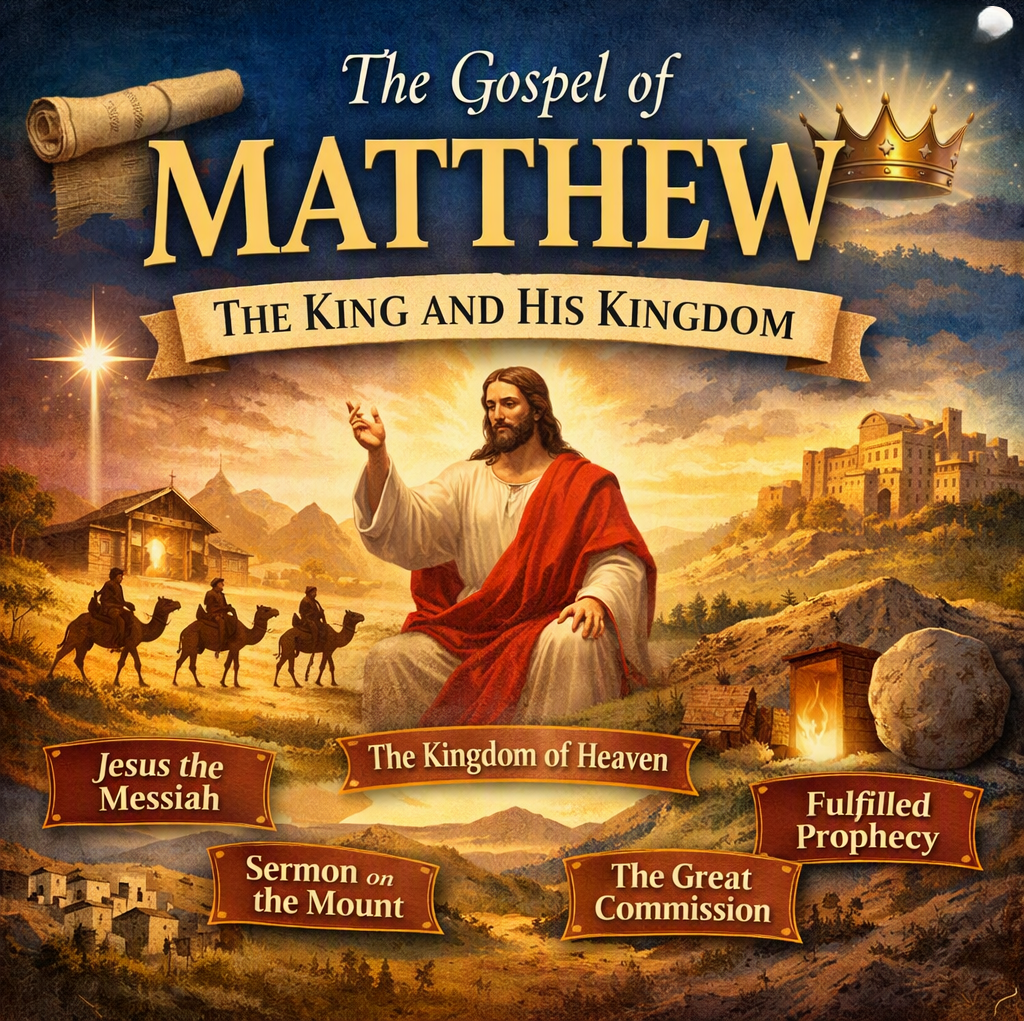
The Gospel of Matthew — The King and His Kingdom
The Gospel of Matthew stands as the bridge between the Old and New Testaments, presenting Jesus as the longawaited Messiah who fulfills God’s promises to Israel. Written with a distinctly Jewish perspective, Matthew shows how Jesus is the true King whose kingdom transforms hearts, communities, and the world.
Authorship & Audience
Early Christian tradition attributes the Gospel to Matthew, the former tax collector turned disciple. His writing reflects deep familiarity with Jewish Scripture, customs, and expectations. Matthew’s primary audience was Jewish believers and seekers, helping them see Jesus not as a break from Israel’s story but as its fulfillment.
Purpose
Matthew writes to proclaim that Jesus is the promised King, the Son of David, whose arrival brings the Kingdom of Heaven near. Through carefully structured teaching sections and fulfillment quotations, he shows that Jesus embodies everything the Law and Prophets anticipated.
Key Themes
- Jesus the Messiah — Matthew repeatedly highlights fulfilled prophecy, showing Jesus as the promised descendant of David and Abraham.
- The Kingdom of Heaven — Central to Matthew’s message is the invitation to enter God’s reign through repentance, faith, and obedience.
- True Righteousness — In the Sermon on the Mount, Jesus redefines righteousness as a matter of the heart, not mere external compliance.
- Discipleship — Matthew emphasizes following Jesus as a lifelong journey of trust, obedience, and transformation.
- Conflict & Rejection — Despite His authority and compassion, Jesus faces opposition from religious leaders who resist the kingdom’s demands.
- Mission to the Nations — Matthew ends with the Great Commission, sending disciples to make followers of Jesus in every nation.
Structure
Matthew organizes his Gospel around five major teaching discourses, echoing the five books of Moses:
- Sermon on the Mount (Ch. 5–7) — The character of kingdom people
- Mission Discourse (Ch. 10) — Instructions for kingdom messengers
- Parables of the Kingdom (Ch. 13) — The mystery and growth of God’s reign
- Community Discourse (Ch. 18) — Life together under the King
- Olivet Discourse (Ch. 24–25) — The King’s return and final judgment
These teaching blocks are framed by narrative sections showing Jesus’ authority through His birth, miracles, compassion, and ultimately His death and resurrection.
Matthew’s Unique Contributions
- The genealogy connecting Jesus to Abraham and David
- The birth narrative including Joseph’s perspective, the Magi, and Herod
- The Sermon on the Mount, the most extensive teaching of Jesus in the Gospels
- Numerous Old Testament fulfillment quotations
- The Great Commission, launching the church’s global mission
Why Matthew Matters Today
Matthew calls believers to recognize Jesus as King—not only of Israel’s story but of our lives. His Gospel invites us to live as citizens of the Kingdom of Heaven, embodying Christlike righteousness, mercy, and mission in a world longing for hope.
More in Articles
October 6, 2026
The Gospel of Mark: A Clear Portrait of the Servant-KingOctober 1, 2026
The Gospel of Matthew: Jesus the King and His KingdomSeptember 8, 2026
The “Minor” Prophets: Hosea Through Malachi