Acts of the Apostles: A Story That Would Not Stay Still
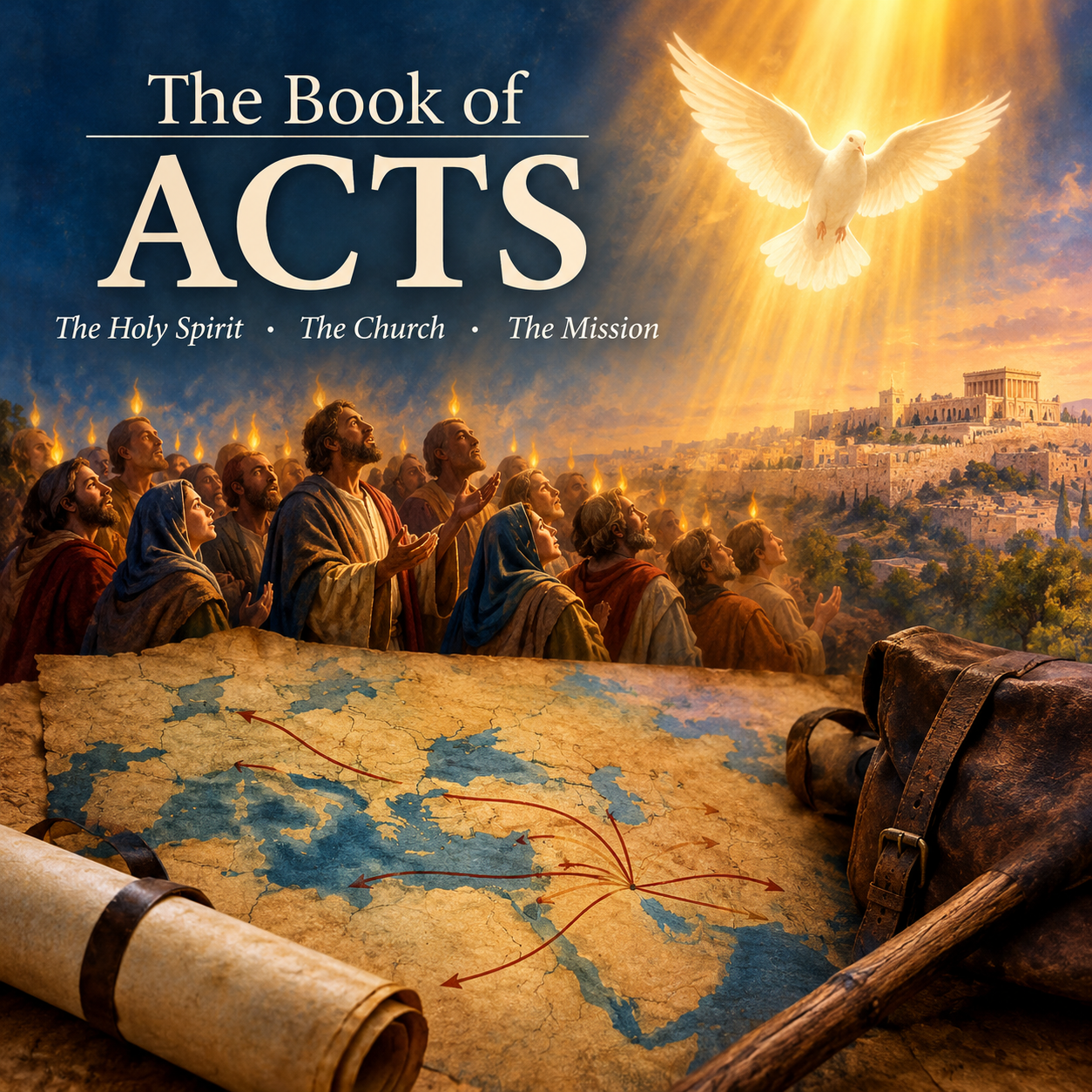
Acts of the Apostles
A Story That Would Not Stay Still
Imagine fifty days after the crucifixion. A small company of frightened, grieving followers huddles in Jerusalem behind locked doors. Then — wind, fire, a sound like a rushing storm — and everything changes. By the time the morning is over, three thousand people have been baptized, and the Church of Jesus Christ has entered the world not with a whisper but with a roar. That is where the book of Acts begins, and it never slows down. Few books of the Bible match its sheer narrative energy: sermons that cut to the heart, miraculous escapes from prison, a blinding encounter on a desert road, riots in the theater district of Ephesus, a shipwreck off the coast of Malta, and a gospel that arrives at last in the capital of the Roman Empire. Acts is the story of an unstoppable mission — and it is the direct sequel to the Gospel of Luke, written by the same hand, addressed to the same reader, and animated by the same conviction that God is doing something in history that cannot be undone.
WHAT IS THE BOOK OF ACTS?
The author of Acts is Luke — the same Luke who composed the third Gospel, and who is identified in Paul's letter to the Colossians as "the beloved physician" (Col. 4:14). He was a Gentile, a careful observer, a traveling companion of Paul, and one of the most gifted writers in the entire New Testament. Together, the Gospel of Luke and Acts constitute a single two-volume work, both addressed to a figure named Theophilus — and that two-volume work is the longest single contribution to the New Testament by any one author. Luke is not merely a chronicler; he writes as an ancient historian of the highest quality, naming officials, cities, and legal customs with a precision that archaeology has repeatedly confirmed.
Acts picks up exactly where the Gospel of Luke ends: Jesus ascending into the heavens, his disciples standing and staring upward, waiting in Jerusalem as he had commanded. From that moment of holy suspension, Acts launches forward. It covers approximately thirty years of early Church history — from the Resurrection and Ascension (around AD 30) to Paul's house arrest in Rome (around AD 60–62). Scholars generally date the book's composition to approximately AD 62–65, a judgment supported by the telling fact that Acts ends without any mention of Paul's death, the Neronian persecution, or the destruction of Jerusalem in AD 70. Luke appears to be writing right up to the edge of the present moment. The result is a book alive with immediacy, one that reads less like a history textbook and more like a dispatch from the front lines of a world being transformed.
THE ORGANIZING PRINCIPLE: A MISSION THAT CANNOT BE STOPPED
If you want to understand Acts, commit Acts 1:8 to memory. Before his ascension, the risen Jesus makes a promise and gives a commission in a single breath: "You will receive power when the Holy Spirit comes on you; and you will be my witnesses in Jerusalem, and in all Judea and Samaria, and to the ends of the earth." This is not merely an inspiring send-off. It is Acts' own built-in outline. The book traces, with remarkable intentionality, the exact geographic expansion Jesus describes — from the upper room in Jerusalem to the palace district in Rome. Every chapter fits somewhere along that journey outward.
The true protagonist of Acts, it must be said, is neither Peter nor Paul — it is the Holy Spirit. The Spirit calls, redirects, empowers, falls, fills, and drives the mission forward at every crucial juncture. Luke underscores this unstoppable advance through a series of carefully placed "progress reports" or summary statements scattered across the book: "And the Lord added to their number daily" (2:47); "The word of God spread" (6:7); "The church throughout Judea, Galilee and Samaria enjoyed a time of peace and was strengthened" (9:31); "The word of God continued to spread and flourish" (12:24); "The churches were strengthened in the faith and grew daily in numbers" (16:5); "The word of the Lord spread widely and grew in power" (19:20). These refrains are Luke's drumbeat — a rhythmic insistence that, regardless of what opposition arises, the Word of God grows. Nothing, and no one, can stop.
MAJOR THEMES
The Holy Spirit. Pentecost is the Church's birthday, and the Spirit is the gift that makes everything possible. Again and again in Acts, the Spirit falls on unlikely people in unlikely places — directing Philip to a desert road, pushing Peter toward a Gentile household, calling Paul and Barnabas out from the church in Antioch for the first missionary journey. The Spirit is not a background presence; he is the engine of the entire narrative.
The Gospel Crosses Every Boundary. One of Luke's deepest concerns is showing how the gospel dismantles every wall human beings erect. Barriers of ethnicity, culture, religious heritage, and social class fall one by one. Jews, Samaritans, Ethiopians, Romans, Greeks, jailers, philosophers, and merchants — all find themselves standing on the same ground before the same Lord. The move from Jerusalem to Rome is not merely geographical; it is theological.
The Suffering Servant Pattern. The apostles follow the path of Jesus in ways they likely did not anticipate. They are arrested, beaten, imprisoned, and in Stephen's case, killed. Yet at every point, suffering becomes the occasion for witness rather than retreat. The pattern is unmistakable: the mission advances precisely through — not around — adversity.
Prayer and Worship. Acts is a book of praying communities. The disciples are at prayer when the Spirit falls. The church prays for Peter in prison, and prison doors open. Paul and Silas sing hymns at midnight in a Philippian jail. Nearly every major turning point in Acts is preceded by or anchored in corporate prayer. Luke is not subtle about the connection between the community's posture of dependence and the mission's forward momentum.
The Word of God Grows. Luke treats "the Word" almost as a living character — a force that spreads, multiplies, prevails, and cannot be confined. This is not accidental. Luke wants his readers to understand that what they are witnessing is not merely the expansion of a religious movement but the active, sovereign work of God through his self-communicating Word.
Repentance, Baptism, and New Life. The pattern of conversion in Acts is strikingly consistent. People hear the gospel proclaimed. They are cut to the heart. They ask what they must do. They repent, are baptized, and receive the gift of the Holy Spirit. From the three thousand at Pentecost to the Philippian jailer at midnight, this is the recurring shape of new life in Acts — and it raises important questions for every generation of the Church about what genuine conversion looks like.
LITERARY DESIGN AND KEY MOVEMENTS
Acts is a carefully constructed literary work, not simply a collection of stories strung together. One of its most elegant structural features is the way Luke organizes the narrative around two great apostolic figures — Peter (chapters 1–12) and Paul (chapters 13–28) — whose careers deliberately mirror each other. Both heal a lame man. Both raise the dead. Both are miraculously freed from prison. Both confront sorcerers. The parallels are too consistent to be accidental; Luke wants us to see that the same Lord is at work through both men, and that the mission is larger than any individual within it.
Movement One — The Church in Jerusalem (Acts 1–7). The Spirit descends at Pentecost. Peter preaches and three thousand are baptized. The community of believers forms — sharing possessions, breaking bread, praying together, and growing daily. Then conflict arrives. Stephen, the first martyr, delivers a sweeping sermon rehearsing Israel's entire history before the Sanhedrin, and is stoned to death. His death scatters the Church — but scattering, as Luke will show, is not defeat. It is the mechanism of expansion.
Movement Two — Persecution Scatters and Expands (Acts 8–12). Philip takes the gospel to Samaria — the second ring in Jesus' commission. An Ethiopian official reads Isaiah in his chariot and goes home baptized. Saul of Tarsus, the Church's most feared persecutor, is knocked to the ground on the Damascus road and encounters the risen Christ in blinding light. Peter receives a vision that shatters his assumptions about clean and unclean — and is sent to the household of Cornelius, a Roman centurion. When the Spirit falls on Cornelius and his household, the Gentile door swings permanently open, and the implications will reshape everything.
Movement Three — Paul's Mission to the Nations (Acts 13–21). Commissioned by the Spirit through the church in Antioch, Paul embarks on three missionary journeys that carry the gospel across Asia Minor, Macedonia, Greece, and the Aegean world. The Jerusalem Council in chapter 15 stands at the structural center of Acts — and of early Church history — as the community gathers to discern, reason from Scripture, and listen to the Spirit about what Gentile inclusion means for the people of God. It is a model of how the Church navigates genuine, consequential disagreement.
Movement Four — Paul's Journey to Rome (Acts 22–28). Arrested in Jerusalem, tried before governors and kings, surviving a dramatic and terrifying sea voyage, shipwrecked on Malta, and finally arrived in Rome — the center of the world — Paul has, in a sense, fulfilled the commission of Acts 1:8. The gospel is at the ends of the earth. And then Luke does something remarkable: he ends the book without a proper ending. Paul is in Rome, preaching and teaching with all boldness and without hindrance — and Luke simply stops. This open ending is widely recognized as intentional. The story is not finished. Luke leaves it open because the mission continues — and because every generation of readers is meant to understand that they are the next chapter.
ACTS AND TODAY'S CHURCH
It would be a mistake to read Acts as mere ancient history — as an account of impressive people in a distant century doing things we can only admire from afar. Luke does not write to produce nostalgia. He writes to produce conviction. Acts is a mirror held up to every generation of the Church, and the reflection it offers is both encouraging and uncomfortable.
What does it mean to be a Spirit-empowered community? Acts answers with striking clarity: bold preaching that does not soften its edges for the sake of social comfort; a love that crosses every boundary of ethnicity, background, and status; a sacrificial sharing of life and resources; and a persistent, corporate dependence on prayer. These are not first-century peculiarities. They are the constitutive marks of the Church in every age.
Acts also confronts the Church's chronic temptation toward insularity. The gospel was never meant to stay in Jerusalem. The disciples' instinct, understandably, was to gather in one place — but the Spirit kept pushing them outward. Every congregation, no matter how vital its internal community, is called to expand its witness beyond its own walls. The mission is always moving toward the next ring: Judea, Samaria, the ends of the earth.
The suffering that runs through Acts — and it is never far from the surface — is a further corrective. Faithfulness, Acts insists, is not measured by comfort or by the absence of opposition. It is measured by courage: the courage to speak, to go, to stay, to endure. The same Lord who sustained Paul through beatings and shipwrecks sustains his people still.
And Acts models something invaluable for a Church that must navigate its own disagreements: the Jerusalem Council of chapter 15 shows us a community that did not avoid a hard question, did not fracture over it, and did not resolve it by the force of any one personality. They gathered. They listened to testimony. They reasoned from Scripture. They discerned together. And the Holy Spirit led them through. That is a pattern the contemporary Church would do well to recover.
Read Acts with fresh eyes, and you will find it is impossible to remain unmoved. Its energy is contagious, its courage is challenging, and its conviction — that the Word of God cannot be stopped, that the risen Christ is alive and at work in his people — is as urgent in Burke, Virginia in 2026 as it was in Jerusalem in AD 30.
The last words of Acts are powerful. Luke tells us that Paul remained in Rome, "proclaiming the kingdom of God and teaching about the Lord Jesus Christ with all boldness and without hindrance" (Acts 28:31). On that note — without hindrance — the book ends, and the Church's story continues. Pick up Acts this week. Read it as if for the first time. Let it surprise you with its speed and its grace, its courage and its joy. The same Spirit who filled that upper room is not finished. He is still at work, still empowering witnesses, still carrying the gospel to the ends of the earth — and still inviting ordinary people, in ordinary places, to be part of the story that cannot be stopped.
More in Articles
November 3, 2026
1 & 2 Corinthians Explained: Unity, Love, and God's GraceOctober 29, 2026
Ezekiel: Visions of Glory and a Heart RestoredOctober 29, 2026
The Book of Romans: Salvation, Grace, and Faith in Christ